
From the archives
Learn about our iconic, pioneering products and advertisements.
-

Eucalyptol Linton Moist Gauze
Linton Moist Gauze was one of the earliest Johnson & Johnson sterile surgical dressings. Raw cotton delivered to the company factory was cleaned, processed and woven into sheets. These sheets were then sterilized and infused with eucalyptus, known for its antiseptic and anti-inflammatory properties. First sold in 1887, Linton Moist Gauze was soon packaged in hermetically sealed fruit jars to ensure that they remained germ free. The product continued to be sold in fruit jars up through the 1920s. -

James Wood Johnson
Founder James Wood Johnson was a talented engineer whose machines powered the company’s first factories. Johnson also found the first Johnson & Johnson building on a fateful train ride through New Brunswick. In January of 1886, he spotted a “for rent” sign on a nearby factory while riding through the city. That building became Johnson & Johnson’s home later that year.


All-electric powerhouse
The Johnson & Johnson Powerhouse (now the Powerhouse Museum) was constructed in 1907 by the company’s early mill superintendent in charge of manufacturing buildings. Using state-of-the-art technology, the building generated electricity that powered the company’s manufacturing machinery. While many factories at the time still ran on steam, through prudent financial planning and a foresight for technology, Johnson & Johnson was able to upgrade.

A view of the Powerhouse under construction.Johnson & Johnson Archives
Browse the archives
-
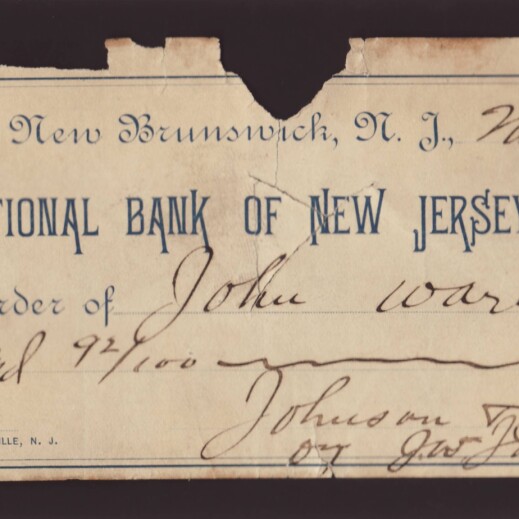
Our first check
Read more1886
On March 25, 1886, James Wood Johnson wrote out the company’s first check to John Ware, the freight master of the Pennsylvania Railroad in New Brunswick. The factory’s close proximity to the railroad allowed for the smooth shipment of raw materials and products to and from the Johnson & Johnson factories to market. The payment was for materials used to make medicated plasters, one of the company’s first products.Image courtesy: Johnson & Johnson Archives -

Edward Mead Johnson
Read more1890
This is the only known photograph of company cofounder Edward Mead Johnson in the Johnson & Johnson Archives. Johnson was a talented advertiser who left the company in the late 1890s to found Mead Johnson Nutrition. Johnson’s company specialized in baby formula and is still in business today.Image courtesy: Johnson & Johnson Archives -

Dr. Simpson’s maternity packet
Read more1894
Johnson & Johnson collaborated with leading obstetricians to design its maternity kits. Dr. Simpson’s Maternity Packet was the original Johnson & Johnson maternity kit. It hit the market in 1894 and was the first of its kind. At the turn of the 20th century, most babies were born at home without the help of a doctor. The packet was equipped with medical products and instructions to make childbirth a safer experience for mothers and infants alike and help reduce maternal and infant mortality surrounding childbirth.Image courtesy: Johnson & Johnson Archives -

Dr. Cooke’s maternity kit
Read more1920
The Dr. Cooke’s Maternity Kit contained products for both childbirth and infant care, including umbilical tape, antiseptic soap, sterile dressings, sterile gauze, obstetrical sheets, and more, as well as directions on how to properly use the supplies during labor and delivery. Since most babies at this time were born at home, the kit helped make delivery and the first days of life safer for mothers and babies.Image courtesy: Johnson & Johnson Archives -

Esmarch triangular bandage
Read more1890
Although the company didn’t invent the Esmarch Triangular Bandage, it was a vital component of Johnson & Johnson’s early first aid cases for railway surgeons that focused on sterile surgical supplies. The illustrated directions printed directly on the bandage served a dual purpose. Not only could they not be lost, but because they were visual diagrams, the instructions were accessible in every language.Image courtesy: Johnson & Johnson Archives -

Red Cross catgut no. 1 ligatures
Read more1907
Johnson & Johnson’s Red Cross Catgut No. 1 Ligatures were a familiar and trusted medical supply common in doctor’s bags and operating rooms during the early 1900s. by 1917, the company was the world’s largest manufacturer of catgut ligatures, producing about 10 million feet each year.Image courtesy: Johnson & Johnson Archives -

Iodized cotton
Read more1886
Iodized Cotton was one of the company’s first surgical supplies. Although it sounds simple, it was a revolutionary product. Prior to its release, most cotton was not absorbent, and none was manufactured under sterile conditions. Sometimes it was shipped to surgeons still in its bolls, covered in dirt. In processing and cleaning the raw plant in an antiseptic factory and packaging the woven cotton in airtight jars, Johnson & Johnson pioneered sterile, absorbent cotton. Iodine was then added to enhance its germ-fighting powers.Image courtesy: Johnson & Johnson Archives -

Eucalyptol Linton most gauze
Read more1887
Linton Moist Gauze was one of the earliest Johnson & Johnson sterile surgical dressings. Raw cotton delivered to the company factory was cleaned, processed and woven into sheets. These sheets were then sterilized and infused with eucalyptus, known for its antiseptic and anti-inflammatory properties. First sold in 1887, Linton Moist Gauze was soon packaged in hermetically sealed fruit jars to ensure that they remained germ free. The product continued to be sold in fruit jars up through the 1920s.Image courtesy: Johnson & Johnson Archives -

No. 2 carbolized catgut ligatures
Read more1887
The No. 2 Carbolized Catgut Ligatures were among the inaugural Johnson & Johnson sterile sutures in 1887.Image courtesy: Johnson & Johnson Archives -

Carlisle dressing
Read more1940
During World War II, Johnson & Johnson mass-produced medical supplies designed for the unique needs of the U.S. Military. Among them was the Carlisle Dressing. It was packaged in a pocket-sized metal container to make it easily portable. The metal packaging also kept the bandage dry and protected until use. The dressing included dense layers of cotton and gauze to treat deep wounds caused by bullets, shells, and artillery. -

Johnson & Johnson, Makati, Philippines
Read more1964
Johnson & Johnson building in Makati, Philippines, 1964. Johnson & Johnson opened its first operating company in the Philippines in 1956 but had been selling products there through sales agents since the early 1900s.Image courtesy: Johnson & Johnson Archives -

First overseas factory
Read more1925
In 1924, Johnson & Johnson opened its first overseas operating company in Slough, England. In hiring all British workers and leadership, the company strived to be attuned to the needs of local patients and consumers. Because the decentralized structure was successful first in Canada and then in England, it became the guiding principle as Johnson & Johnson continued to expand its operations across the world. This photograph of the company’s Slough location dates from 1925.Image courtesy: Johnson & Johnson Archives


Our heritage
Discover Johnson & Johnson’s long legacy of pioneering human health.
Company timeline
Through our timeline, discover the company’s pioneering role in the field of healthcare.
Our stories
Learn how we’re improving the health and lives of people worldwide.